Report of the Neighbourhood Meeting – Thursday 26 February
On Thursday, 26 February, the neighbourhood meeting of Belvédère Residents’ Platform took place. We would like to thank all neighbours who attended for their involvement and contributions. A special word of thanks goes to our guest speakers, Pieter-Paul van der Wouw, District Coordinator for the City Centre, and Erwin Gerardu, Project Leader for a Resilient Society.
________________________________________
Opening and review of the Residents’ Platform
Dyana van Breemen, chair of the Belvédère Residents’ Platform, opened the evening by warmly welcoming everyone present and explaining the purpose of the meeting: to inform, connect and look ahead together.
She then gave an extensive overview of the origin and development of the Belvédère Residents’ Platform. The platform was established in 2024 following a clear need among residents to be structurally involved in discussions and decision-making regarding developments in the neighbourhood. In May 2025, the platform was officially established as a foundation, formalized through a notarial deed and registered with the Dutch Chamber of Commerce.
A conscious decision was made to adopt a simple and efficient organizational structure with formally a chair and a treasurer. This open structure prevents unnecessary bureaucracy and allows energy and time to be focused primarily on substantive issues, resident participation and concrete neighbourhood projects.
The core of the platform is participation. For this reason, thematic working groups have been established in which residents actively contribute ideas and collaborate on topics affecting the neighbourhood, such as:
- Liveability and public space
- Traffic and mobility
- Sustainability and greening
- Culture and social connection
The strength of this approach is that knowledge, experience and signals from the neighbourhood are directly brought into discussions with the municipality and other stakeholders. The platform therefore acts as a connecting link between residents and local government, as well as a knowledge and advisory point representing the neighbourhood itself.
________________________________________
Development and expansion of the working area
The meeting also discussed the development of the platform’s working area in more detail.
When the initiative started in 2024, the focus was on Sphinx-South. This was the area where the first concrete questions and initiatives originated. However, the municipality indicated that Sphinx-South could not be recognized as a separate working area. Instead, the entire Statenkwartier neighbourhood was suggested.
For residents who have lived here longer, it was clear at the time why immediately expanding to the entire Statenkwartier would not be desirable. Therefore, it was initially decided to focus on the Belvédère development area, roughly defined as the area behind the fire station.
In practice, however, residents from the “older” part of the Statenkwartier also expressed a desire for support, representation and a point of contact with the municipality. The question was raised repeatedly as to why they were not included within the platform.
These signals were taken seriously. In September 2025, during a meeting with the core members, it was decided to expand the platform’s working area to include the entire Statenkwartier. This decision was made to ensure inclusivity and broader representation of the neighbourhood.
Within the foundation we work with core members. Our aim is to have at least one committed resident from every street, neighbourhood section or apartment complex who participates as a core member.
Why is this important?
A neighbourhood is not a homogeneous entity. Each street has its own dynamics, its own points of attention and sometimes its own concerns. What is happening in Busschuttenpoort may not automatically be visible or noticeable in, for example, the Brusselse Straat. Without local representation, there is a risk that important signals will be noticed too late or not at all.
Core members therefore fullfil an essential connecting role. They:
• identify what is happening in their immediate living environment
• bring issues, ideas and initiatives to the platform
• help think about solutions and priorities
• mobilize fellow residents when necessary, for example during participation processes or when collecting signatures
• serve as a low-threshold point of contact within their street or building
Through this fine-grained structure, we ensure that the platform truly represents the entire neighbourhood and not just a small part of it. It strengthens legitimacy, encourages engagement and allows us to act more effectively in discussions with the municipality and other stakeholders.
In this way, the platform remains accessible, representative and closely connected to the entire Statenkwartier.
________________________________________
Ongoing projects
Greening of Sphinx-South
The project aimed at increasing greenery in Sphinx-South is progressing well. The municipality is currently in contact with homeowners’ associations (VvEs) regarding maintenance agreements. In addition, a suitable contractor is being sought for the implementation. Due to the current shortage of contractors, this process may take some time. Suggestions for suitable companies are welcome.
Sphinx-North
Regarding the Sphinx-North project — in which Karin Rutten, Mathieu Vermin and Jan Bierhoff are actively involved on behalf of the working group — we can conclude that the participation process is proceeding carefully and constructively.
Residents’ wishes and conditions are clearly being taken seriously. Even in the current phase, in which discussions are taking place with potential contractors for the development project, we are present at the table together with the Sphinxkwartier Foundation as a full discussion partner. This means that resident influence is not limited to a consultation moment after decisions have already been made, but is structurally embedded in the decision-making process.
Furthermore, the tender documentation explicitly states that both residents and entrepreneurs must be involved throughout the entire process, from planning to execution. Participation has therefore been contractually embedded.
This project demonstrates how participation should work: not informing residents after decisions have been made, but working together from the very beginning, balancing interests and communicating transparently. This is an approach of which our neighbourhood can truly be proud.
________________________________________
Neighborhood activities
In addition to the annual National Neighbours’ Day celebration and the Spring Lunch — which have been organized since 2020 — there is now a bi-weekly coffee gathering every Thursday from 12:00 to 14:00. This is an informal and accessible meeting moment where residents can drop in without registration to meet each other, share signals and strengthen social ties. This informal setting has proven to be very valuable for neighbourhood connection.
In addition, a neighbourhood gathering is organized once a month on Friday evening. This allows residents who work during the day to get to know each other better. The social network within the neighbourhood is visibly strengthening as a result.
Attention is also given to the youngest residents. A children’s morning with changing themes is organized once a month. This helps involve families in neighbourhood life and encourages children to feel at home in their community.
Looking ahead to 2026, we plan to expand the activities programme with shared outings, such as a visit to the zoo or a boat trip to Liège. These activities are not only enjoyable but also contribute significantly to social cohesion and mutual trust.
Ultimately, a strong neighbourhood is not only about projects and physical developments, but also about connection between residents. Strengthening that connection remains the core of our efforts.
________________________________________
Safety and liveability
Pieter-Paul van der Wouw attended the meeting on behalf of the municipality. He explained that staff members from the municipal enforcement department (T.H.O.R.) unfortunately could not attend due to a large-scale operation taking place that evening.
Waste-related issues
Residents raised concerns about:
- polluted waste collection points
- garbage placed next to containers
- waste being put outside too early
- late-night nuisance related to the nightlife area
- pests and hygienic problems
Residents asked whether it would be possible to adjust waste collection times or increase the number of containers.
________________________________________
Resilient society
Erwin Gerardu provided an explanation of the theme “Resilient Society.”
In addition to the importance of having an emergency kit, he emphasized the importance of mutual support and organization in case of emergencies. More information will follow in the near future. There are also plans to establish a central neighbourhood point where residents can go for assistance if communication systems fail.
________________________________________
Announcements
• The Social Hub: some residents will receive an invitation to join a special programme that includes free coffee on Sundays and invitations to various events.
• Extra attention was requested for the traffic situation on Frontensingel. Work is already being done on this issue and further information will follow.
________________________________________
Closing
The meeting concluded with thanks to all attendees for their involvement and constructive contributions.
The evening once again demonstrated that cooperation, participation and mutual connection form the foundation of a safe, liveable and strong neighbourhood.
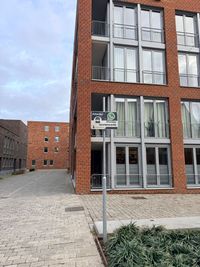
Neighbourhood Safety in the Sphinx Quarter
Recently, a number of unfortunate incidents have taken place in our neighbourhood. These include a daytime home burglary and the theft of bicycles and scooters from the parking garage during the night. Naturally, we hope these incidents are now behind us, but staying alert remains important.
In the past, our neighbourhood has also experienced nuisance and safety concerns. At that time, a fellow resident set up the Veilig Sphinx kwartier WhatsApp group. This group enables residents to quickly and easily share information about suspicious situations and helps us work together towards a safer living environment.
In the meantime, neighbourhood watch signs have been placed throughout the area to make it clear that we actively cooperate on neighbourhood safety.
If you are not yet registered for the WhatsApp group, you can sign up by sending an email to
veiligsphinxkwartier@gmail.com including your name, address, phone number and email address.
Please note: this WhatsApp group currently does not cover the entire Statenkwartier, but only Sphinx-Zuid and Maagdendries. If there is interest in setting up a similar neighbourhood watch WhatsApp group in other parts of the Statenkwartier, please let us know. We will be happy to take this forward.
Together, we help keep our neighbourhood safe 👀🤝
From Sirens to Social Life:
the Fire Station of Maastricht’s Statenkwartier
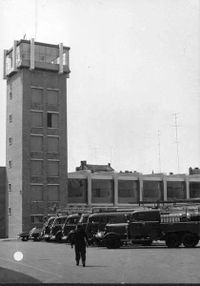
Anyone walking along the Capucijnenstraat in Maastricht’s Statenkwartier today will notice a striking building that radiates calm and creativity. Large doors, solid lines and an open feel. Yet for decades, this was a place where calm was rare. This was once the beating heart of the city’s fire brigade.
The fire station was built in 1959, during a period of growth and modernization in Maastricht. From this central location, firefighters responded to emergencies across the historic city centre and surrounding neighbourhoods. Sirens, urgency and teamwork shaped the rhythm of everyday life. Next to the station stood a firefighters’ residential block, allowing crew members and their families to live close by and respond quickly when the alarm sounded.
For more than forty years, the building played a crucial role in safeguarding the city. But as Maastricht evolved, so did its infrastructure. In 1999, the fire brigade relocated to a modern facility on the edge of the city, better suited to increasing traffic and faster response routes. The old station was left behind — silent, empty and without its familiar sirens.
Yet this was not the end of the story, but the beginning of a new chapter. Rather than demolish the building, the municipality chose to give it a new purpose. With great respect for the original architecture, the former fire station was transformed into a place for creativity, entrepreneurship and social connection. The careful renovation was recognised with the Victor de Stuers Award, a prestigious prize for architectural and cultural heritage preservation.
Today, the building is once again full of life — though in a very different way. Where fire engines once stood ready, people now gather at long tables in the Brandweerkantine, working, meeting, eating and sharing ideas. Elsewhere in the complex, creative professionals, designers and makers have found their home. The former fire station has become an integral part of the cultural energy of the Statenkwartier and the nearby Sphinx Quarter.
In this way, the old fire station tells a distinctly Maastricht story: a building that evolves alongside the city itself. From a place of urgency and public service to one of inspiration and encounter. The sirens have fallen silent, but the heart of the building still beats — now to a different rhythm.
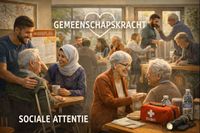
Social attention in the neighbourhood –
together we make sure no one stands alone
In more and more neighbourhoods, there is a growing awareness that living well together is not only about beautiful streets and new buildings, but above all about caring for one another. Knowing who your neighbours are. Noticing when someone is struggling. And knowing what to do when help is suddenly needed.
In a conversation recently shared by Math Reintjes, Carmen explains how her parish was of invaluable support to her after her husband passed away. Not through big words or formal services, but through simple acts: someone stopping by to listen, a meal left at her door, help with paperwork. The real strength did not lie in the organisation itself, but in the community around it.
What stands out in her story is how natural it is for people to look out for one another. There is a fixed place where people meet, neighbours see each other regularly and immediately notice when someone is missing. When something happens – a fall, illness or sudden emergency – a network of neighbours quickly forms to help with groceries, visits and practical support.
This is exactly what we mean by social attention: being aware of one another, picking up signals and being willing to act. We can strengthen this in our own neighbourhood as well. A good neighbourhood emergency plan does not start with lists and phone numbers, but with connection. When you know each other, you are more likely to ring a doorbell. And you are better able to recognize who may be more vulnerable in emergency situations, such as during extreme heat, power cuts or personal crises.
The living room activities of the Belvédère Residents’ Platform can play an important role in this as a neighbourhood support point. A place where residents meet, where information comes together and where – when needed – people can quickly be connected: neighbours who need help and neighbours who are able to offer it.
Activities such as the coffee mornings and neighbourhood drinks are not “extras”, but the very foundation. They help us get to know each other, build trust and notice who does — or does not — show up. That is exactly what makes a neighbourhood resilient.
So the question is not whether we can build a strong social network in the Statenkwartier.
That network already exists — in small but meaningful ways.
The next step is to work together on a simple neighbourhood emergency plan and to further develop a clear and recognizable support point in the neighbourhood.
So that no one has to stand alone — especially when it truly matters